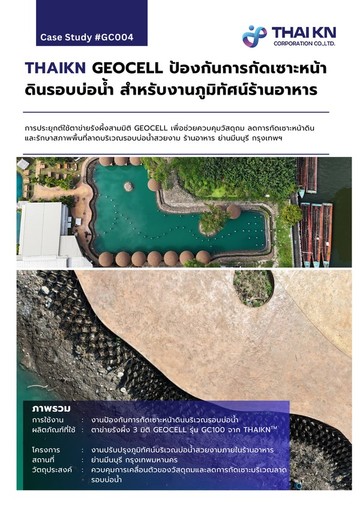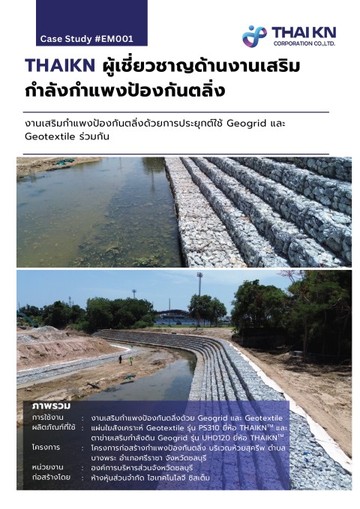






Bank Protection and Erosion Control
Bank erosion protection systems using geosynthetics
Bank erosion can occur along rivers, canals, reservoirs, water storage ponds, drainage channels and areas exposed to flowing water. As water continually carries away or washes out soil at the bank surface, the bank may lose its shape, retreat or affect the stability of surrounding areas.
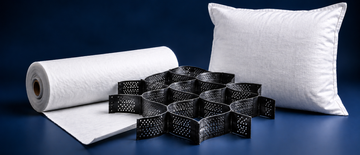
Using Geosynthetic materials is one approach to bank protection and erosion control. Materials such as GEOBAG, GEOCELL, GEOTEXTILE and GEOMAT serve different functions, from forming bank protection structures and confining slope surface materials to soil filtration and separation, and erosion control with vegetation.
Selecting a suitable system requires consideration of site conditions, slope gradient, soil properties, water levels, flow velocity and direction, and the forces acting on the actual site.
What causes bank erosion?
Bank damage rarely has a single cause. It results from interacting hydraulic, soil and site factors. Understanding these causes is an important step before selecting a bank protection system.
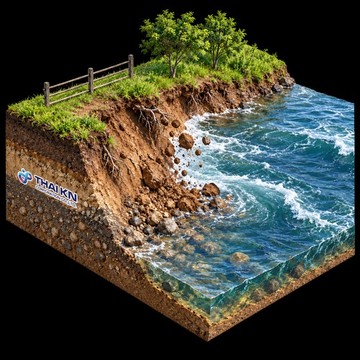
Erosion from flowing water
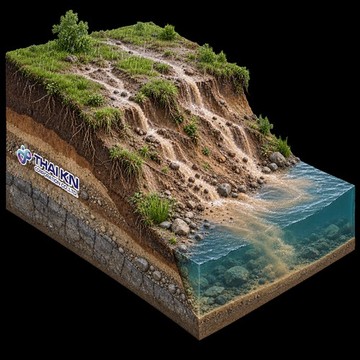
Rainfall and surface runoff
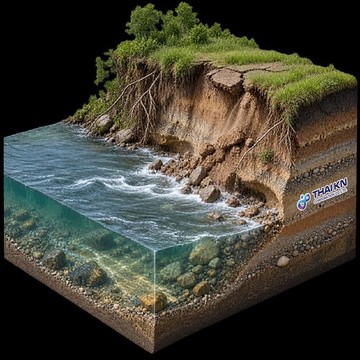
Soil loss at the bank toe
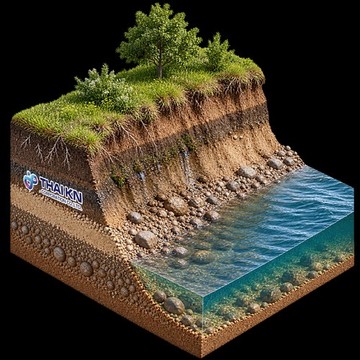
Changes in water level
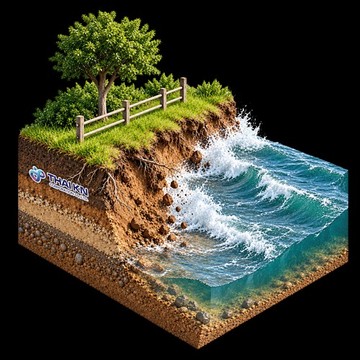
Wave impact on banks
Bank Protection and Erosion Control
Geosynthetics can serve several functions in bank protection systems. Material selection should therefore focus on the required function rather than the product name alone.
Erosion Control
Confinement
Filtration
Separation
Bank Protection Structure
such as GEOBAG systems.
Vegetation Support
Geosynthetic systems for bank protection
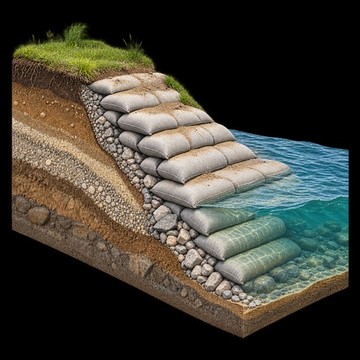
GEOBAG Bank Protection
GEOBAG is a bag made from geotextile. It can be filled with soil, sand or materials specified in the design and arranged in layers to form a structure along the bank.
Related material: GEOBAG
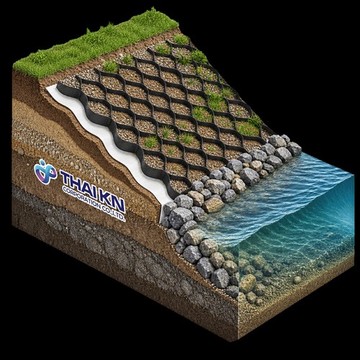
GEOCELL Bank & Slope Protection
GEOCELL has a three-dimensional cellular structure that can be filled with soil, stone or aggregate to confine and restrict the movement of materials on slope surfaces.
It can be used on bank slopes to control materials and reduce surface erosion, potentially with GEOTEXTILE beneath it as a filtration or separation layer. The infill type, anchoring system and installation details must suit the slope gradient and site hydraulic conditions.
Related materials: GEOCELL and GEOTEXTILE
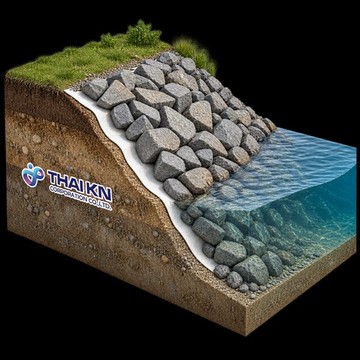
Riprap Protection with GEOTEXTILE
In riprap bank protection systems, GEOTEXTILE can be installed between the existing soil and riprap as a filtration and separation layer. It helps control soil particle migration from below while allowing water to pass through according to the material properties.
This system therefore requires consideration not only of stone size but also of the filter layer properties and supporting soil conditions.
Related material: GEOTEXTILE
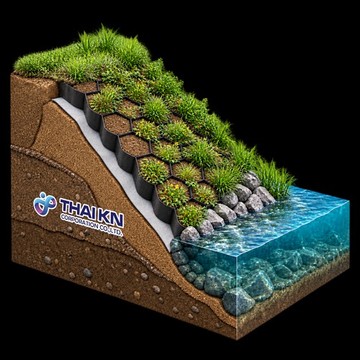
Vegetated Bank Protection
Where a green bank slope is required, GEOCELL can be combined with soil and vegetation to help control topsoil loss and retain slope surface materials.
Vegetated bank protection is suitable where flow conditions and design requirements support the use of vegetation. It should not be assumed to replace hard protection systems in every location subject to high hydraulic forces.
Related material: GEOCELL
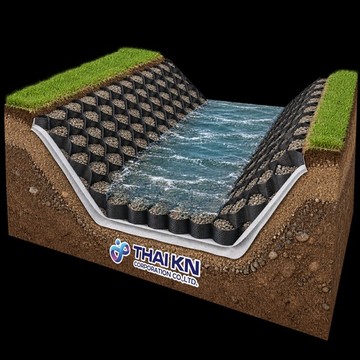
Channel Protection
For canals and drainage channels, GEOCELL can confine materials on the channel bed and sides, together with GEOTEXTILE for filtration or separation.
The design should consider flow velocity and characteristics, infill material, channel gradient and the system's ability to withstand the actual forces.
Related materials: GEOCELL and GEOTEXTILE
Factors to consider before designing a bank protection system
Before selecting GEOBAG, GEOCELL or GEOTEXTILE, consider at least soil conditions and type, bank height and gradient, flow velocity and direction, maximum and minimum water levels, water level changes, waves and hydraulic forces, drainage, bank toe conditions, system materials and the required service life.
The key point is that no single bank protection material is suitable for every site. Many projects may require several geosynthetic types, each serving a different function within the same system.
FAQ : Bank protection
What causes bank failure?
Banks can erode or lose stability due to several factors, including currents, waves, changing water levels, surface runoff, toe erosion, soil properties and slope gradient.
Can GEOBAG be used for bank protection?
Yes. GEOBAG can be filled with soil, sand or specified materials and arranged as a bank structure to help prevent erosion. Its size, arrangement, supporting base and fill must be designed to suit the site.
How is GEOCELL used for bank protection?
GEOCELL confines soil, stone or aggregate within its cells and restricts the movement of slope surface materials. It can be combined with GEOTEXTILE and vegetation according to the system configuration.
Why is GEOTEXTILE used in bank protection?
GEOTEXTILE can act as a filtration and separation layer between the existing soil and protection materials above, such as riprap or GEOBAG, helping control soil particle migration while allowing water to pass according to the material properties.
How do GEOBAG and GEOCELL differ?
GEOBAG is a geotextile bag filled and arranged as part of a bank protection structure. GEOCELL is a three-dimensional cellular structure for confining materials on ground or slope surfaces. Their functions and design methods therefore differ.