




What is WOVEN GEOTEXTILE? Its key functions in earthworks and road works
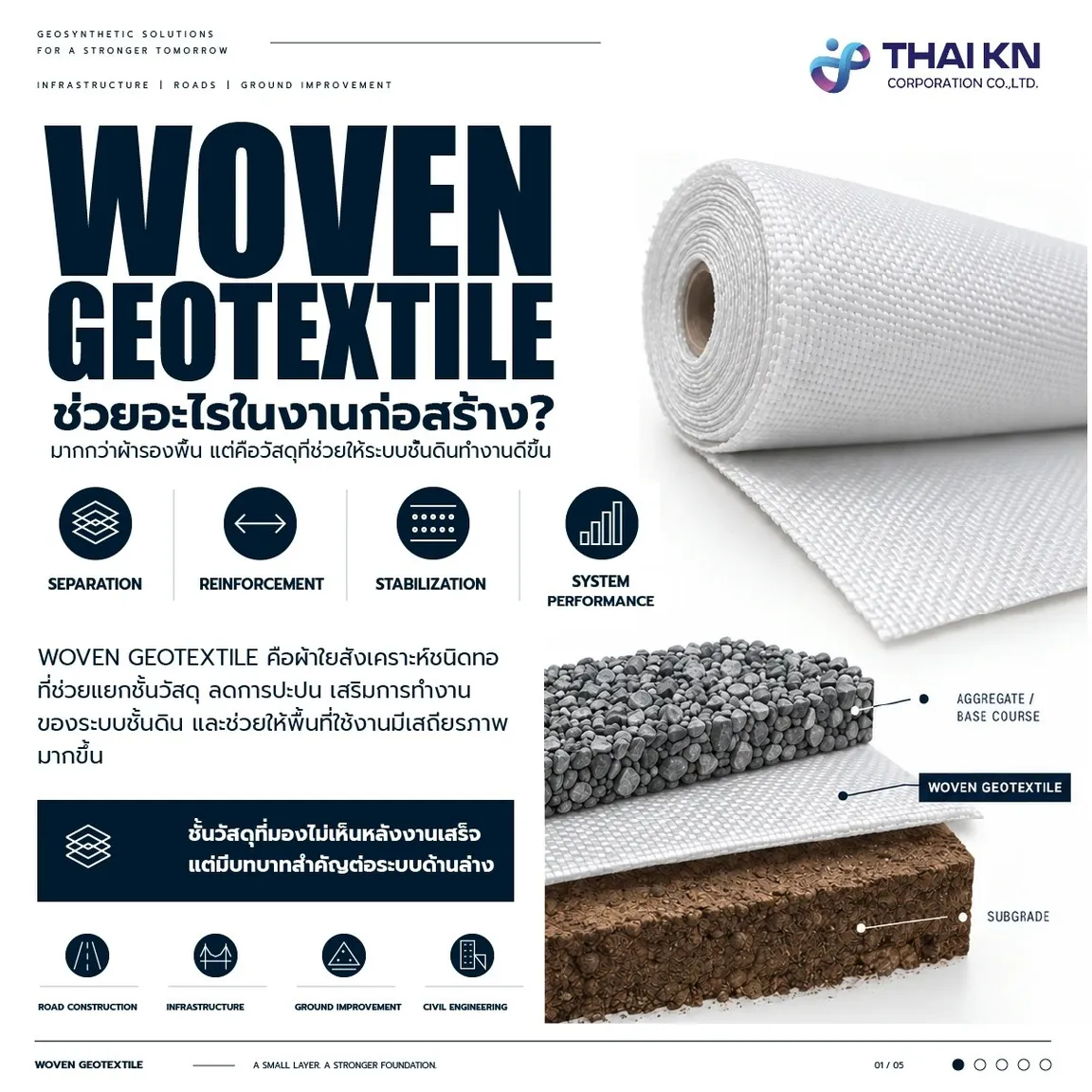
More than an underlay fabric: WOVEN GEOTEXTILE is a Geosynthetic material that works together with soil and aggregate to help pavement systems perform more effectively.
Why is WOVEN GEOTEXTILE important in construction?
When building roads, parking areas, Working Platforms or construction areas on existing ground, the problem is not only “can the soil carry the load?”
There is also the mixing of materials, movement of soil layers, and water conditions within the system, all of which can affect the performance of the pavement layers.
One of the Geosynthetics used to help manage these problems is WOVEN GEOTEXTILE, or woven geosynthetic sheet.
Many people may think WOVEN GEOTEXTILE is just a fabric laid down before placing stone, but in reality Geotextile can have several functions, such as Separation, Filtration and Reinforcement, and can be part of a Stabilization system depending on product properties and design.
What is WOVEN GEOTEXTILE?
WOVEN GEOTEXTILE is a Geotextile produced by weaving Polymer yarns or tapes into an orderly structure.
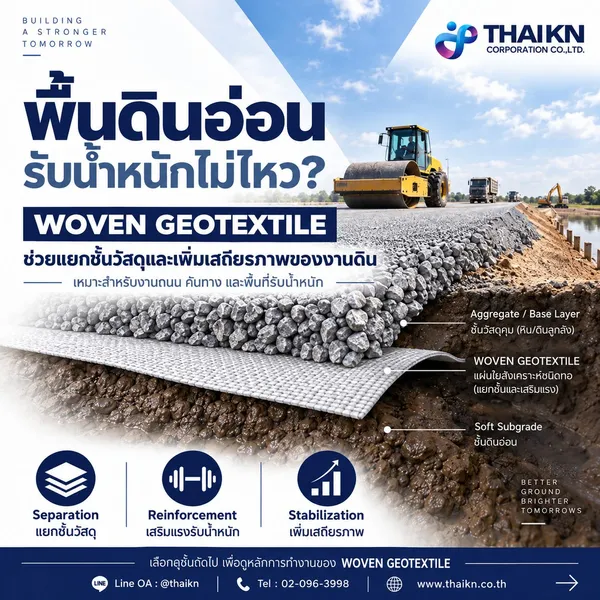
The woven structure gives the material tensile properties suitable for certain applications, and it can be used as a separating layer between the existing soil and aggregate such as Aggregate or Base Course.
WOVEN GEOTEXTILE should not be selected on weight per area alone; its engineering properties should be considered in relation to the function of the system.
- Tensile Strength (MD/CD)
- Tensile Elongation
- Apparent Opening Size
- CBR Puncture Strength (stated in the TDS of WP Series and WH Series)
These values can be checked in the Technical Data Sheet (TDS) of each model.
Separation — separates soil and aggregate layers
One of the key functions of Geotextile in road works is Separation, or keeping material layers apart.
Imagine soft soil underneath, with crushed rock or Aggregate filled directly on top of it.
When vehicles or machinery pass over repeatedly, the stone can gradually sink into the soil, while fine soil can move up and mix into the stone layer.
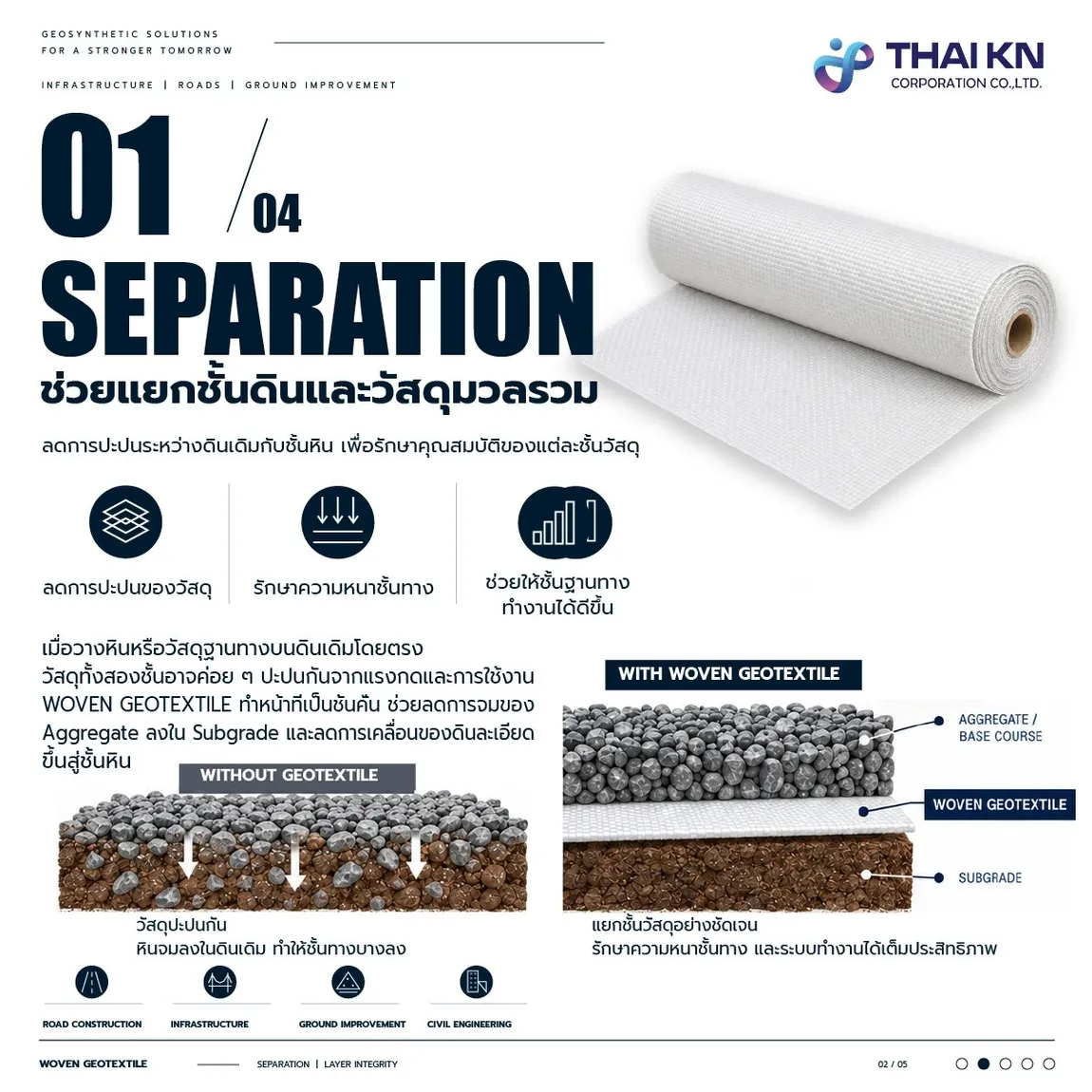
As mixing increases, the properties of the Base or Subbase layer may change and the performance of the pavement layers may decrease.
WOVEN GEOTEXTILE can act as a separating layer between two types of material to reduce mixing and help each layer keep its own function.
International Geosynthetics Society (IGS) describes Separation as preventing materials or soils with different properties from mixing, for example using Geotextile between a Road Base and a Soft Subgrade.
Reinforcement — supports the performance of the soil layer system
Soil and Aggregate can carry compression well up to a point, but under loads from vehicles or machinery the material tends to move sideways.
Some types of WOVEN GEOTEXTILE have tensile capacity, and when friction develops between the geosynthetic sheet and the soil or Aggregate, the material works with the system to help resist movement.
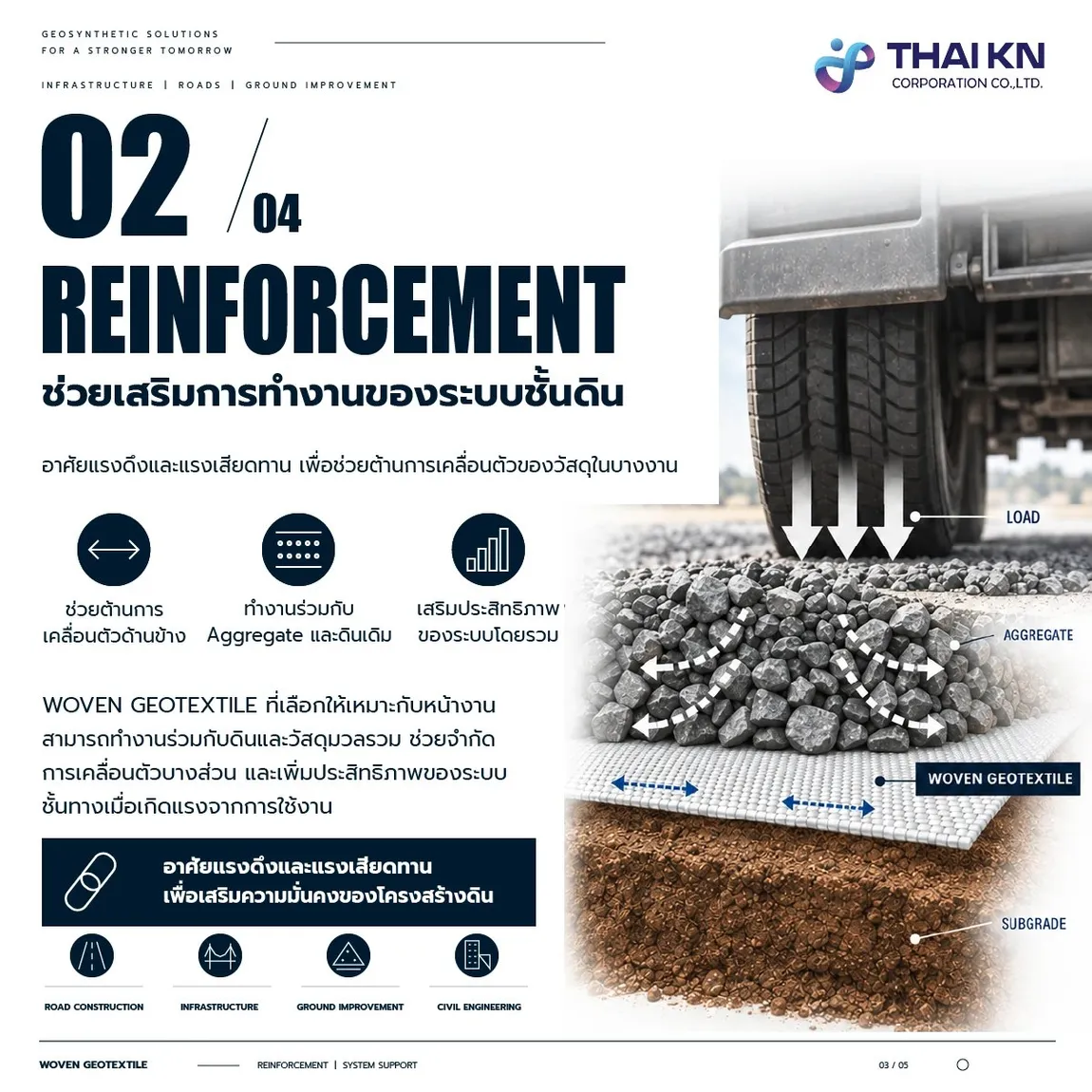
Research report FHWA/TX-08/0-4829-1 by the Center for Transportation Research, The University of Texas at Austin, prepared together with TxDOT and FHWA, explains that a Geotextile with good friction (Friction) can provide tensile resistance (Tensile Resistance) against lateral movement of Aggregate.
In some types of Reinforcement work, Geogrid may play a more prominent role, so material selection should start from the Function the project needs, not from the product name alone.
For work that mainly requires reinforcement of pavement layers, see the details of Geogrid soil reinforcement grid for consideration.
Stabilization — helps improve the stability of pavement layers
The word Stabilization often suggests a function of the material alone, but in engineering it is the result of several mechanisms working together.
For work on a Soft Subgrade, the system may rely on Separation to keep the Aggregate apart from the existing soil, and Reinforcement to help resist movement or deformation, depending on material properties and design.
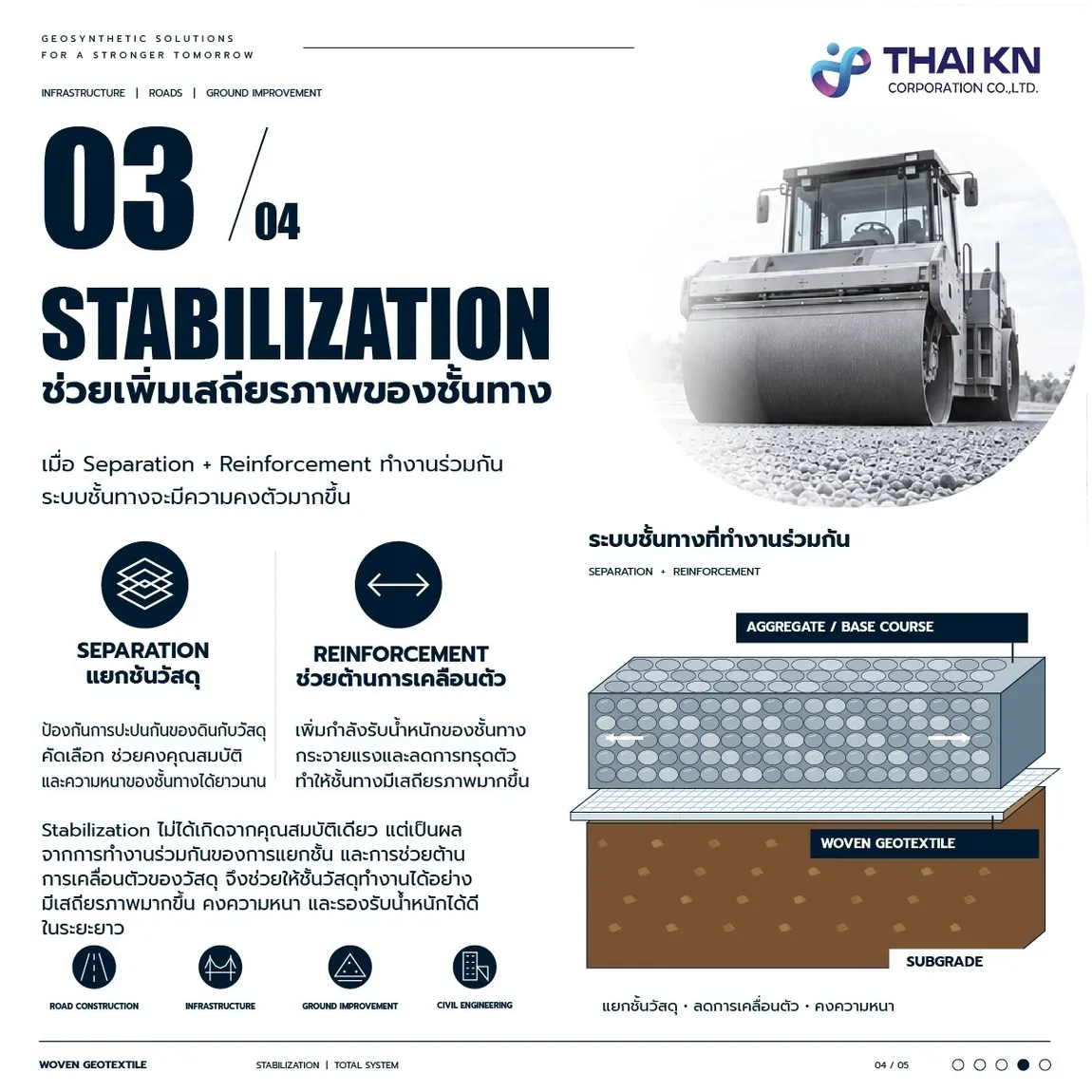
When WOVEN GEOTEXTILE is used together with properly designed Aggregate, Subgrade, material layer thickness and Drainage system, the whole system can become more stable.
Performance Improvement — why does the system work better?
Performance Improvement is not a standard Geosynthetic Function name; it is the desired result when the various functions work together properly.
For example, when WOVEN GEOTEXTILE separates the Subgrade from the Aggregate well, the stone layer can keep its properties better than when fine soil mixes up into the Base Course.
When the system controls the movement of Aggregate better, it can help reduce the accumulation of deformation under certain conditions.
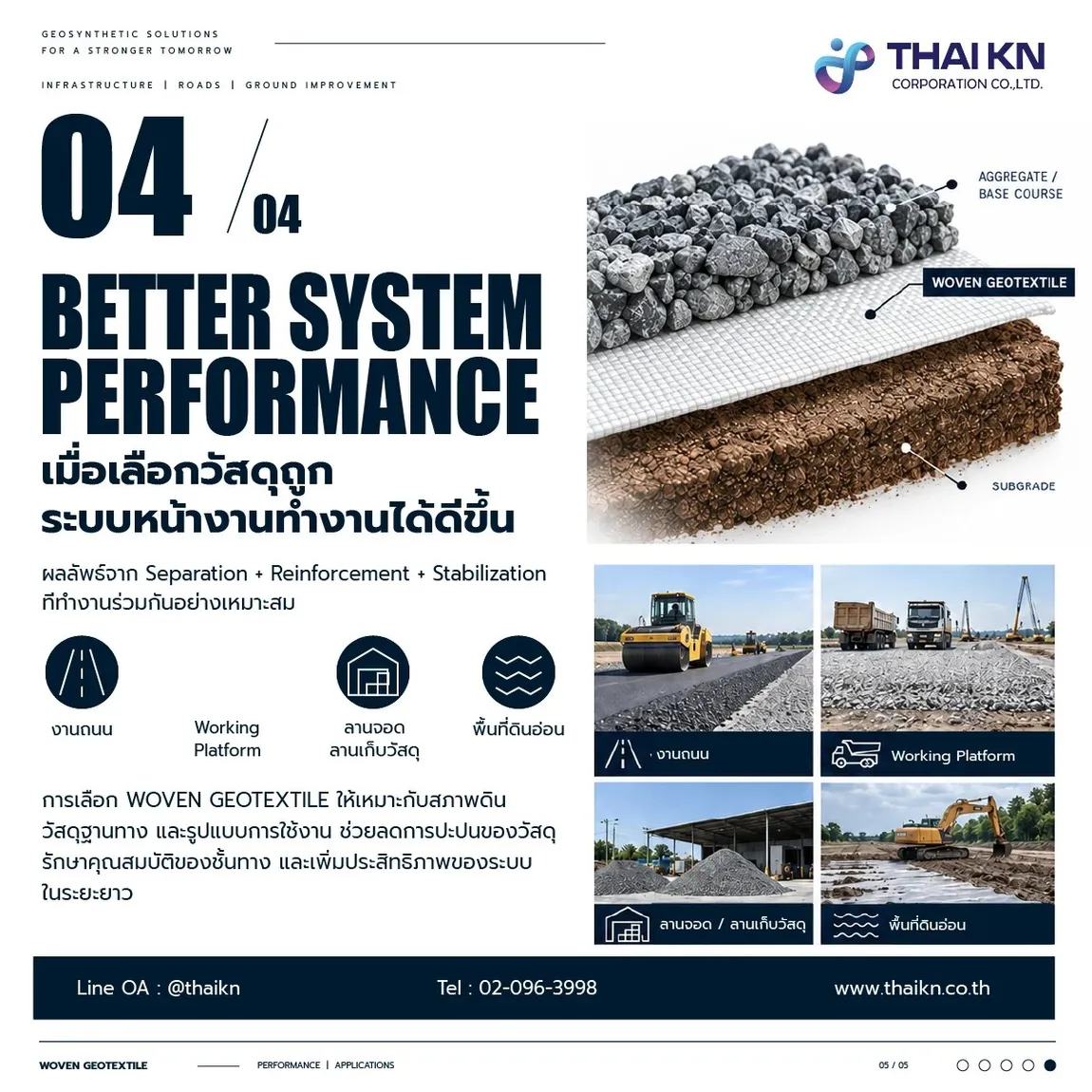
Desired results from the system
- Helps maintain Base Course thickness
- Reduces mixing between Aggregate and the existing soil
- Makes construction on soft Subgrade more systematic
- Helps reduce system deformation under certain conditions
- Helps keep pavement layer performance close to the design
What is WOVEN GEOTEXTILE suitable for?
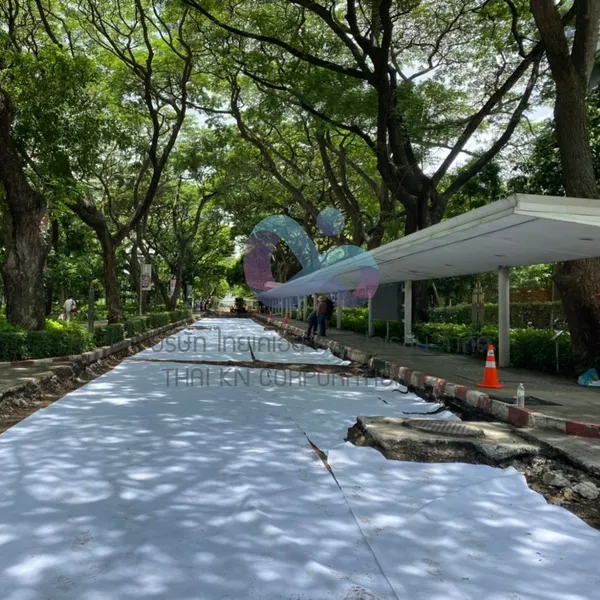
WOVEN GEOTEXTILE can be applied to many types of work, with the Specification chosen to suit the Function and actual site conditions.
Roads / Road Construction
Used as part of the system to help separate material layers and maintain the properties of the road base.Working Platform
Areas supporting machinery or construction on a Subgrade with low strengthParking areas / material storage yards
Used in areas that need to control mixing and maintain the quality of the material layers.Soft ground
Can be used as part of a Ground Improvement system according to the engineering design.How are WOVEN and NON WOVEN GEOTEXTILE different?
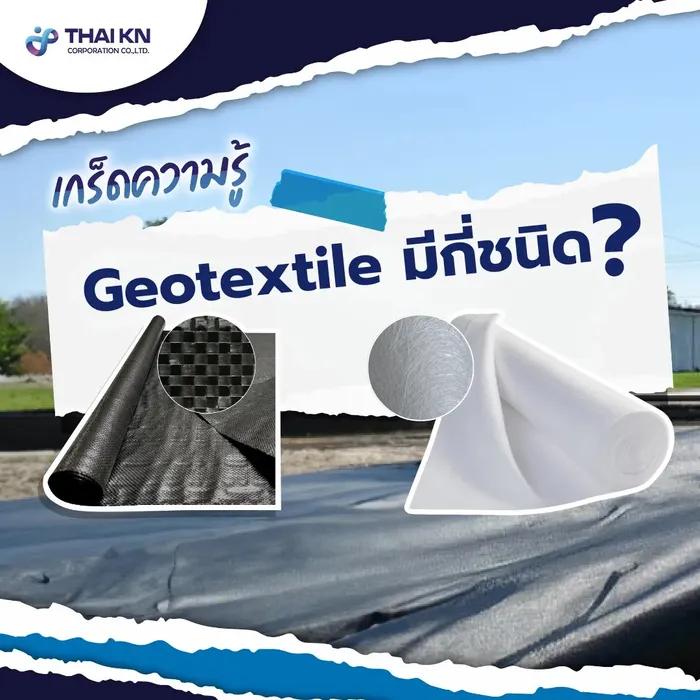
Both types belong to the Geotextile family, but they differ in manufacturing structure and engineering properties.
WOVEN GEOTEXTILE
Made from Polymer yarns or tapes woven into an orderly structure.
Often considered for Separation and for work requiring tensile properties according to the design.
NON WOVEN GEOTEXTILE
Made from fibers bonded together without weaving.
Commonly used for Filtration, Drainage, Separation and Protection, depending on product properties.
For each Geotextile product, the actual engineering values should be checked and the product selected to match the project's Function.
See product details for THAIKN™ Woven Geotextile woven geosynthetic sheet, which comes in several models by tensile strength and material, such as WE Series (Polyester) and WP Series (Polypropylene), and Non-Woven Geotextile non-woven geosynthetic sheet for work focused on Filtration and Drainage.
What to look for when choosing WOVEN GEOTEXTILE
Material selection should start with the question “What do we need the Geotextile to do?”
Then consider the site conditions and the relevant engineering values:
- Soil type
- CBR, or Subgrade strength
- Aggregate size
- Loads
- Traffic volume and type
- Water conditions on site
Then compare them with the values stated in the TDS of each THAIKN™ Woven Geotextile series.
- WE Series (Polyester): Tensile Strength (MD/CD), Tensile Elongation, Apparent Opening Size (O90) and roll size
- WP Series (Polypropylene): Tensile Strength (MD/CD), Tensile Elongation, Trapezoidal Tear, CBR Puncture Strength, Apparent Opening Size (O95), weight per area (Unit Weight) and thickness (Thickness)
- WH Series (Polyethylene): Tensile Strength (MD/CD), Tensile Elongation, Trapezoidal Tear, CBR Puncture Strength, Apparent Opening Size (O95), weight per area (Unit Weight) and thickness (Thickness)
If you are not sure which model suits your site, or the project specification requires values not found in a general TDS, we recommend sending your site information to the THAIKN team to help select a model that matches the project's conditions.
Summary: what does WOVEN GEOTEXTILE do in construction?
WOVEN GEOTEXTILE is not just a fabric laid under stone; it is a Geosynthetic material that works together with earthwork and road systems.
Key functions found in designs include Separation, Filtration and Reinforcement, and it can be part of a Stabilization system.
The desired result is less mixing of materials, preserved pavement layer properties, controlled movement, and a more effective system underneath.
The most important thing is choosing WOVEN GEOTEXTILE that matches the Function and the actual site conditions.
Not sure whether your site should use WOVEN or NON WOVEN GEOTEXTILE?
If you have construction drawings, site photos, soil data or site details, send them to the THAIKN team and we can give you initial advice.