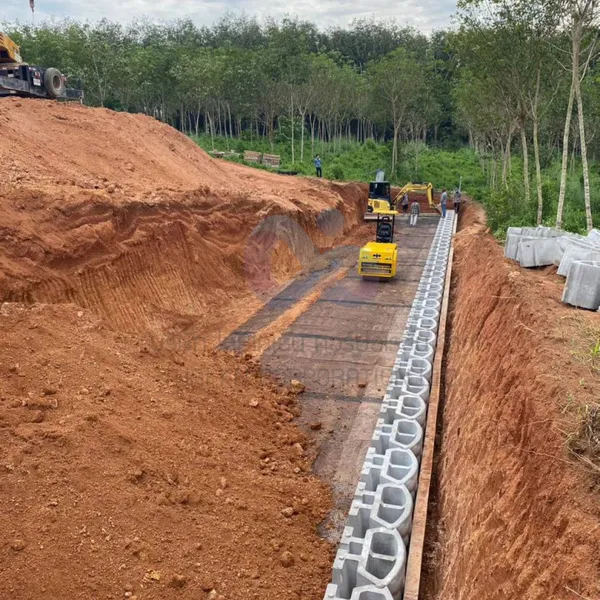






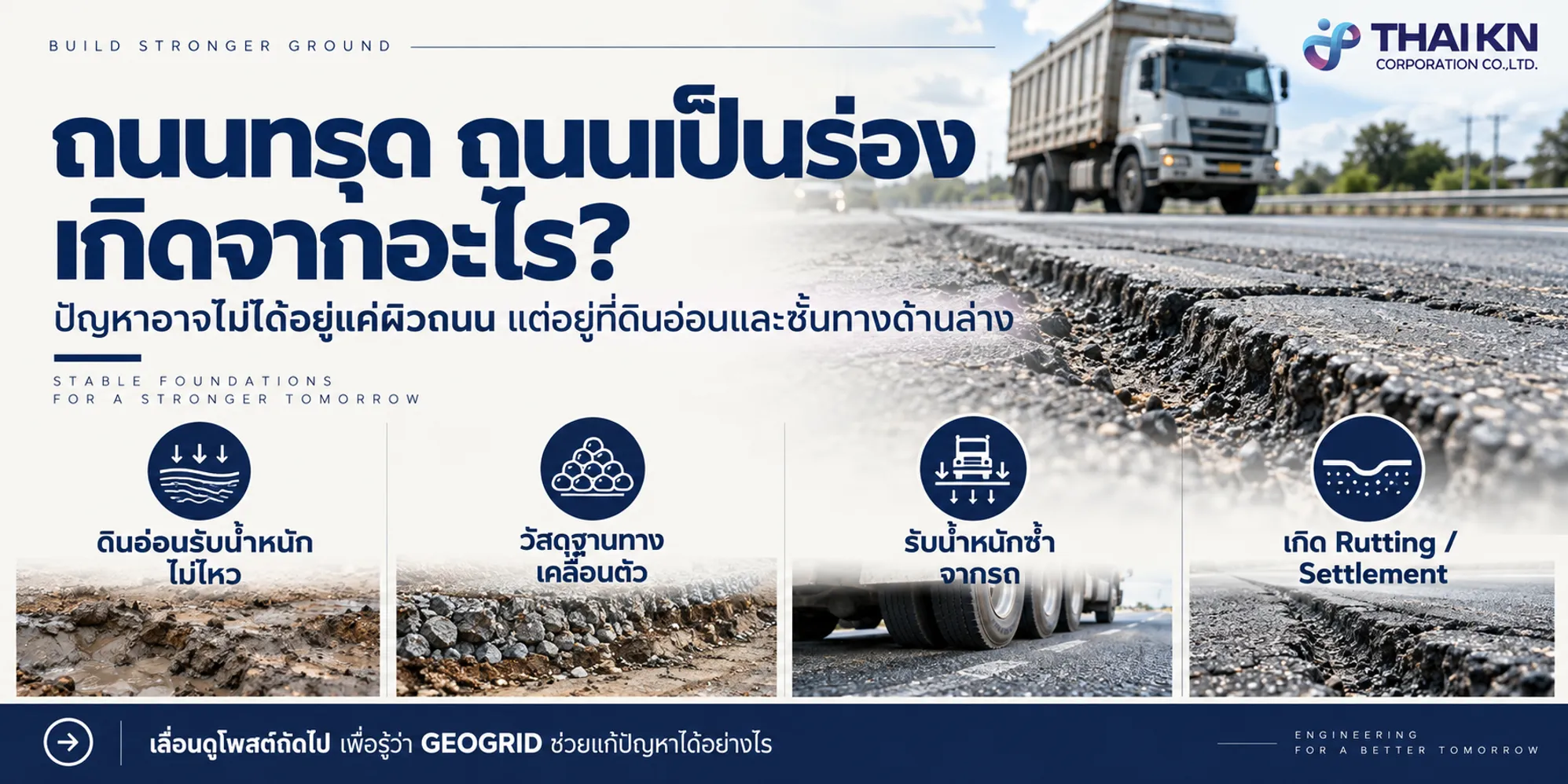
What Causes Road Settlement and Rutting?

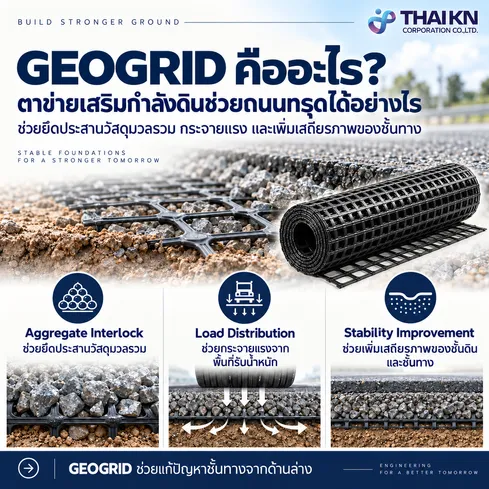
What is GEOGRID? How does a soil reinforcement grid help reduce road settlement and rutting?
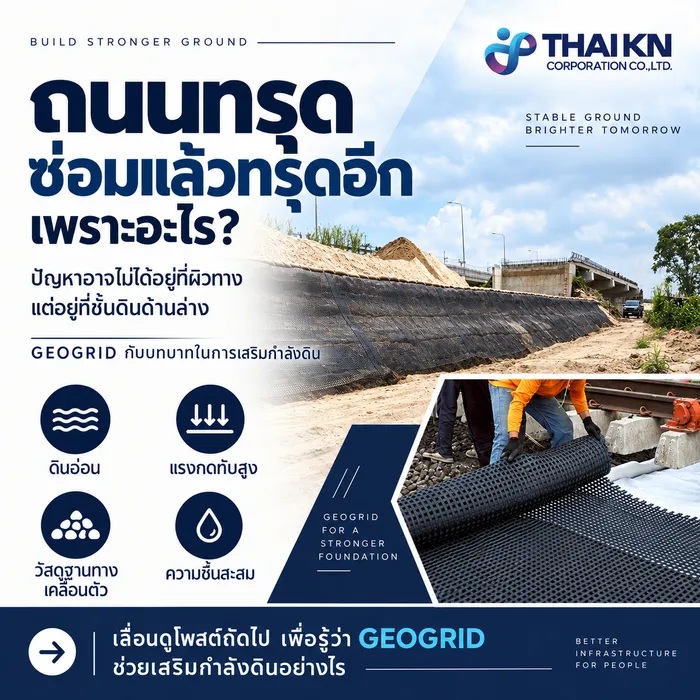
Problems such as road settlement, rutting, deformed road surfaces, or roads that fail again after repair are not always caused by the road surface alone.
In many cases, the problem starts with the existing soil or the base material layer below that is not strong enough. Under repeated loads from vehicles and machinery, the aggregate can move sideways, causing the pavement layers to deform and wheel ruts to form.
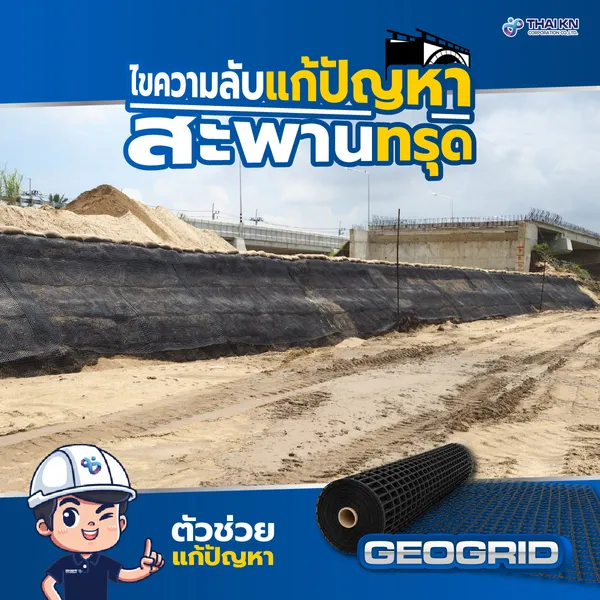
One of the Geosynthetics used to help improve the stability of pavement systems is GEOGRID, or soil reinforcement grid.
FHWA explains that geogrid can help resist lateral movement of aggregate and increase the load-bearing capacity of the pavement system when properly selected and designed.
What is GEOGRID?
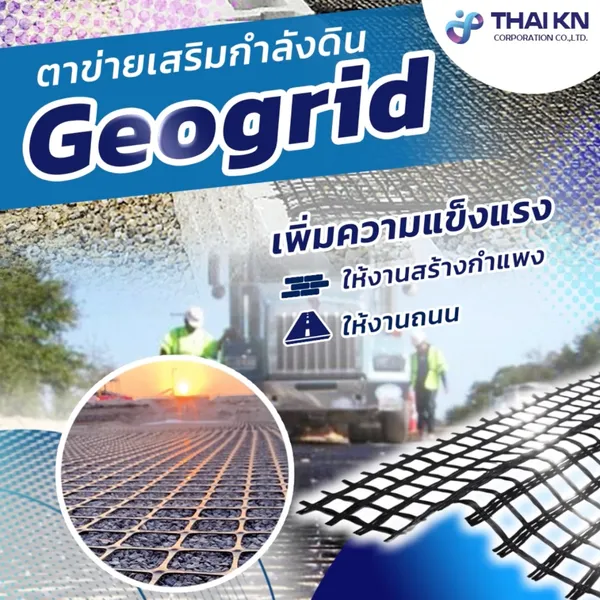
GEOGRID is a Geosynthetic material with a grid or mesh structure, with openings called Aperture
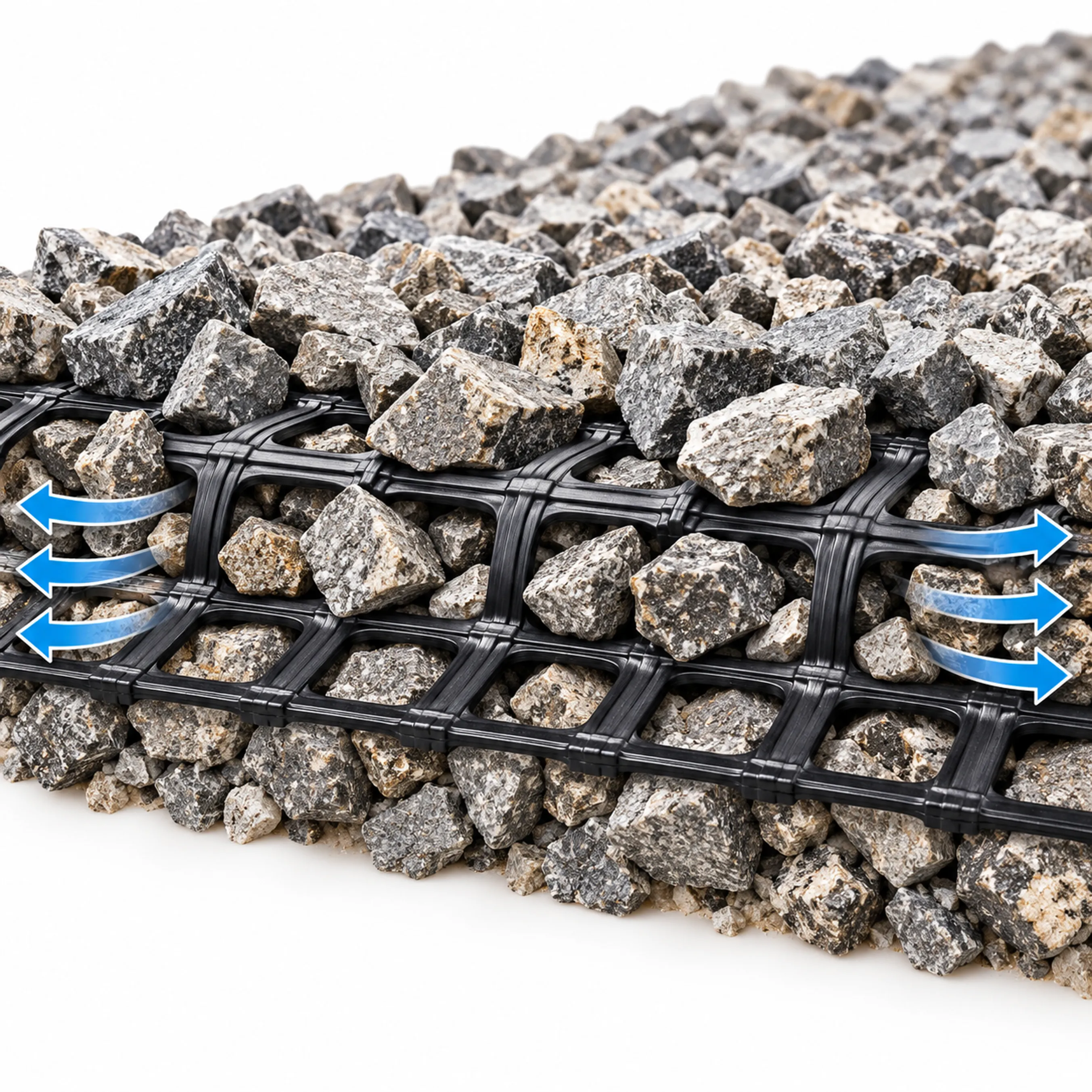
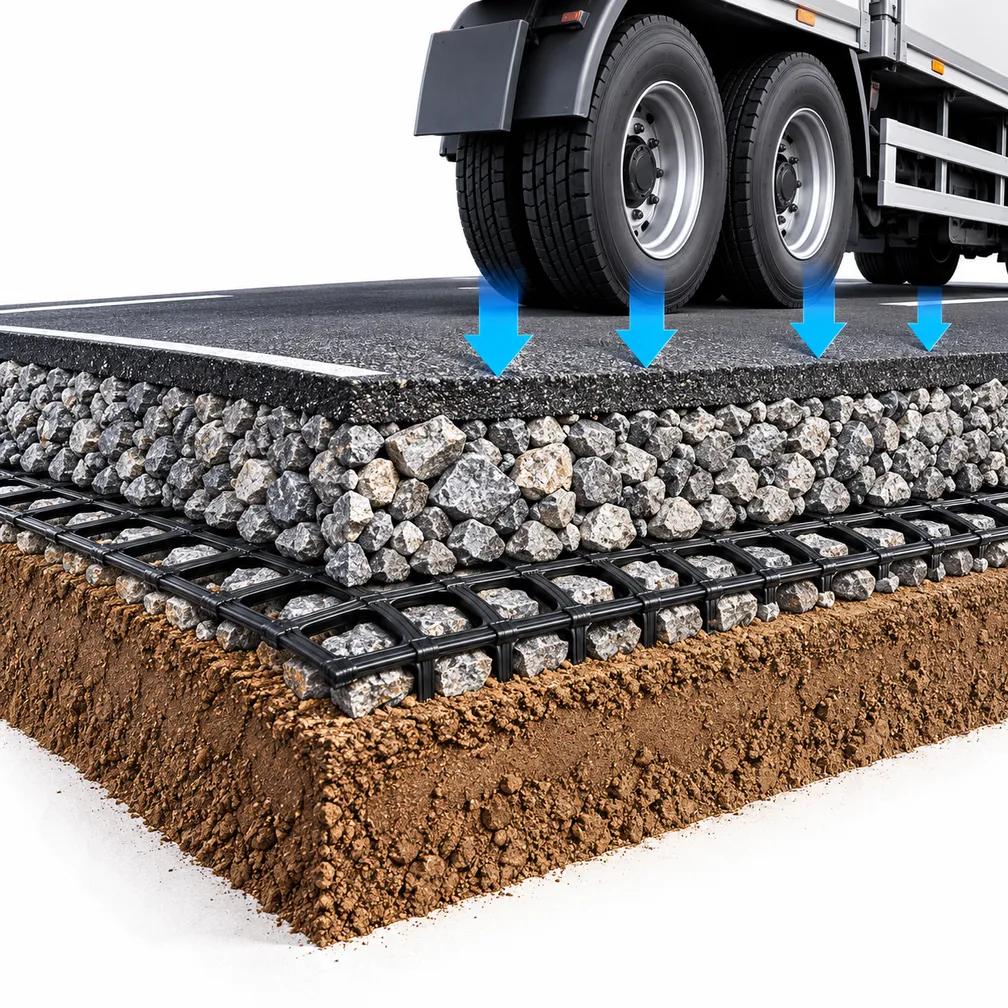
When GEOGRID is installed with stone or Aggregate and compacted, some of the aggregate locks into the grid openings, so the GEOGRID and the Aggregate work together.
This process is often called Mechanical Interlock or Aggregate Interlock.
The International Geosynthetics Society states that Geosynthetics can perform many functions, such as Reinforcement, Stabilisation, Separation and Drainage, and GEOGRID is widely used for Reinforcement and Stabilisation in road works and earthworks.
Why do roads settle or develop wheel ruts?
Imagine the stone layer under a road as a pile of stones with nothing holding it together.
When trucks or machinery press down repeatedly, some of the stones gradually move sideways, and the material layer changes shape.
When this happens repeatedly over a long time, you may see symptoms such as:
- Wheel ruts in the road
- Surface settlement
- Deformed pavement layers
- Movement of the road base
- More frequent maintenance
Academic work published through IGS explains that when Aggregate is loaded by traffic, the material tends to move laterally, and the use of Geosynthetic Reinforcement can help restrict this movement.
How does GEOGRID help solve pavement layer problems?
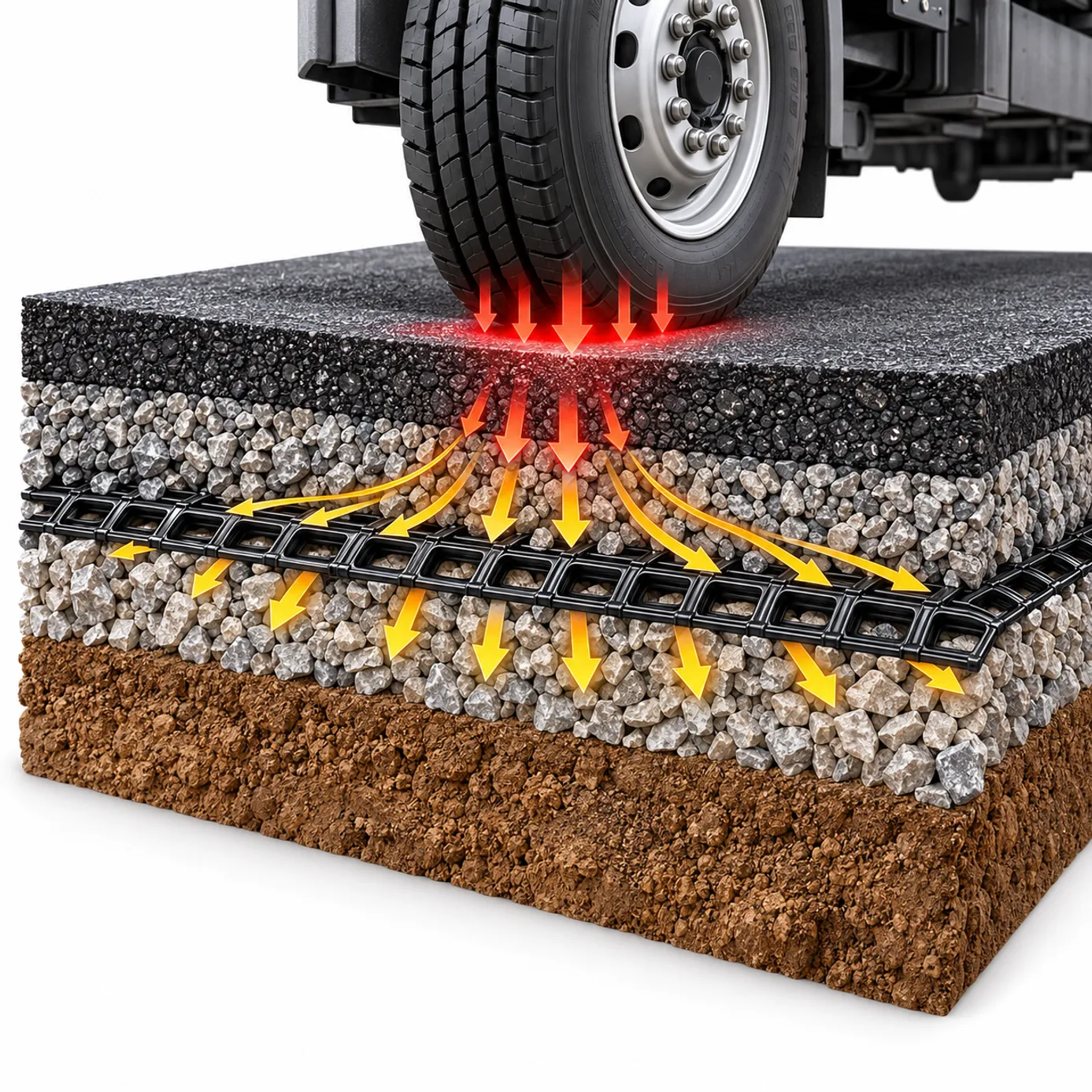
In road works, GEOGRID does not act like an ordinary “underlay sheet”; it works together with the aggregate to create a more stable material layer.
1. Aggregate Interlock — interlocks the aggregate
The GEOGRID openings allow some of the stone and aggregate to penetrate or lock into the grid.
Once compacted, the Aggregate interlocks with the GEOGRID, reducing the movement and rotation of the stone particles.
As a result, the Aggregate layer becomes more stable and better able to resist lateral movement.
Interlocking and control of lateral movement, or Lateral Restraint / Confinement, is a key mechanism of using Geogrid in pavement layers.
2. Load Distribution — helps distribute loads from load-bearing areas
When vehicles pass, wheel loads are transmitted down through the Asphalt, Base and Subbase layers to the existing soil, or Subgrade.
If the supporting ground is soft, loads may concentrate and cause deformation easily.
When GEOGRID works with the Aggregate and helps control material movement, the pavement layers can work as a stiffer and more stable system, which helps spread the effect of loads over a wider area.
FHWA states that Geosynthetic reinforcement can increase the load-bearing capacity of the system by changing the load path through the soil layers and using a wider load-bearing area.
3. Stability Improvement — helps improve the stability of soil and pavement layers
When the Aggregate is kept from moving easily, the pavement layers become more stable.
The desired result is to help reduce the accumulation of deformation from repeated loading, which is one of the causes of Rutting and settlement of pavement layers.
IGS explains that Stabilisation with Geosynthetics can help control deformation of the Soil–Geosynthetic Composite system and plays an important role in both paved and unpaved roads.
What can GEOGRID be used for?
GEOGRID is not only used for roads; it can be applied to many types of work.
Roads and pavement layers
This is one of the most common applications.
GEOGRID can be installed within the Base or Subbase layer, or at the interface between material layers, to help Stabilize the Aggregate and improve the stability of the pavement system.
Suitable for
- General roads
- Internal project roads
- Temporary roads
- Truck roads
- Haul Road
- Construction areas
Work on soft ground
Areas with a Soft Subgrade often have problems with load-bearing capacity.
FHWA states that Geosynthetics can be used with an Aggregate layer to help Stabilize areas with a soft or wet Subgrade, with the design related to soil conditions and material layer thickness. Federal Highway Administration
IGS likewise states that Geogrid and Geotextile are used to improve the performance of unpaved roads and Working Platforms on soft to medium-stiff soils. IGS
Embankments
GEOGRID can be used in reinforced soil systems to carry tensile forces and improve the stability of the soil mass.
In this type of work, the main function may differ from Stabilisation of pavement layers, because GEOGRID carries tensile forces and works together with the Soil Mass to increase the stability of the structure.
Working Platform
Areas for cranes, excavators or heavy machinery need a stable supporting surface.
Using GEOGRID with Aggregate can help create a Mechanically Stabilized Layer, making the working area stiffer and reducing deformation.
Parking areas and load-bearing areas
such as
- Parking areas
- Factory yards
- Container yards
- Logistics Yard
- Truck areas
- Heavy machinery areas
The working principle is similar to road works: GEOGRID is used to help control the Aggregate and improve the stability of the structure below.
Can GEOGRID help reduce maintenance costs?
In principle, if GEOGRID is properly selected and designed, improving the stability of the Aggregate layer and reducing accumulated deformation can help improve the performance of the road system.
FHWA reports that Geosynthetic reinforcement of the Base under suitable conditions can deliver significant performance benefits for the Pavement Section.
However, one should not conclude “how much GEOGRID will reduce repair costs” without project data, because actual results depend on the design, materials, existing soil, traffic volume and construction quality.
Summary: who is GEOGRID suitable for?
GEOGRID is a Geosynthetic material that can be used to help reinforce and improve the stability of soil and pavement layers.
In road works, the key mechanism is the combined action of GEOGRID and Aggregate, which helps:
interlock the aggregate → restrict lateral movement → increase stability → help the pavement system carry loads more effectively
It can therefore be applied to roads, soft ground, embankments, Working Platforms, parking areas and various types of load-bearing areas.
However, GEOGRID should be selected based on the required function and actual site conditions, not on cost or a single tensile strength value alone.
If you have drawings, site photos, soil data or project details, send them to the THAIKN team and we can give you initial advice on choosing GEOGRID.

Line OA : @thaikn
Tel : 02-096-3998, 063-467-9666, 063-401-9888
Email : sale@thaikn.co.th
Website : www.thaikn.co.th
#GEOTEXTILE #Geogrid #thaikn #Geocell #GCL #Geomembrane #HDPEGeomembrane #Landscaping #PondLining #DIYLandscaping #MinimalistGarden
Related Geogrid articles and projects
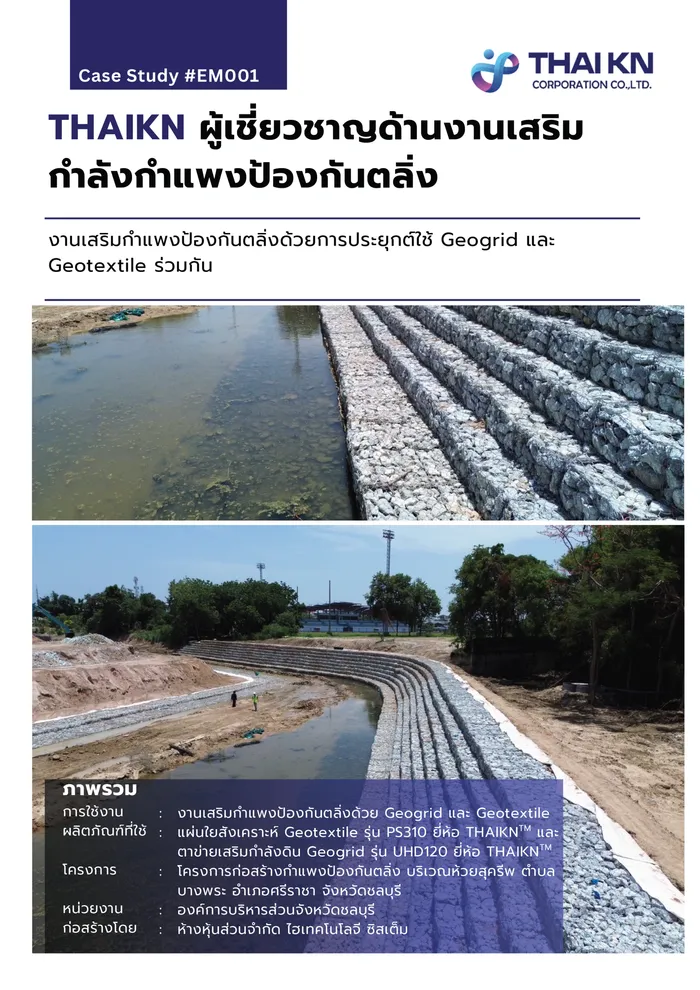
Read more about soil reinforcement and see real installation examples by THAI KN