




What Causes Riverbank Failure? 5 Erosion Causes
A riverbank does not fail from a single cause, but from water, soil and site conditions acting together. Understanding the causes is therefore an important step before choosing a protection system. This article summarises five causes of riverbank erosion and explains what GEOCELL and GEOTEXTILE do in the system, so that materials can be chosen according to the function the site actually needs.
Why do you need to understand the causes before choosing a riverbank protection system?
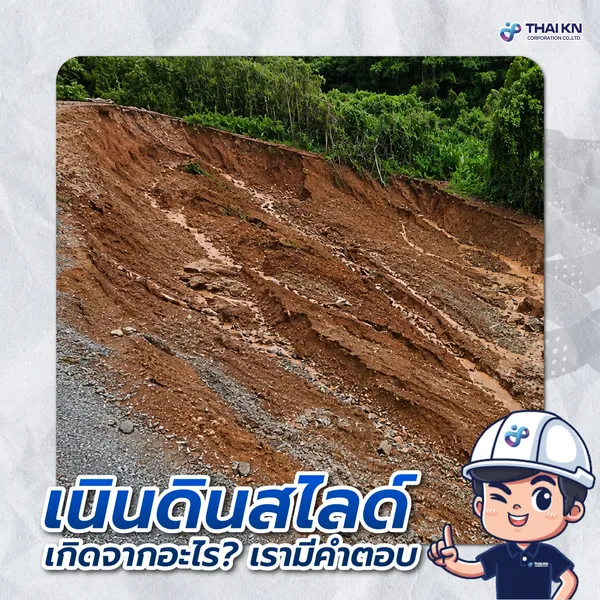
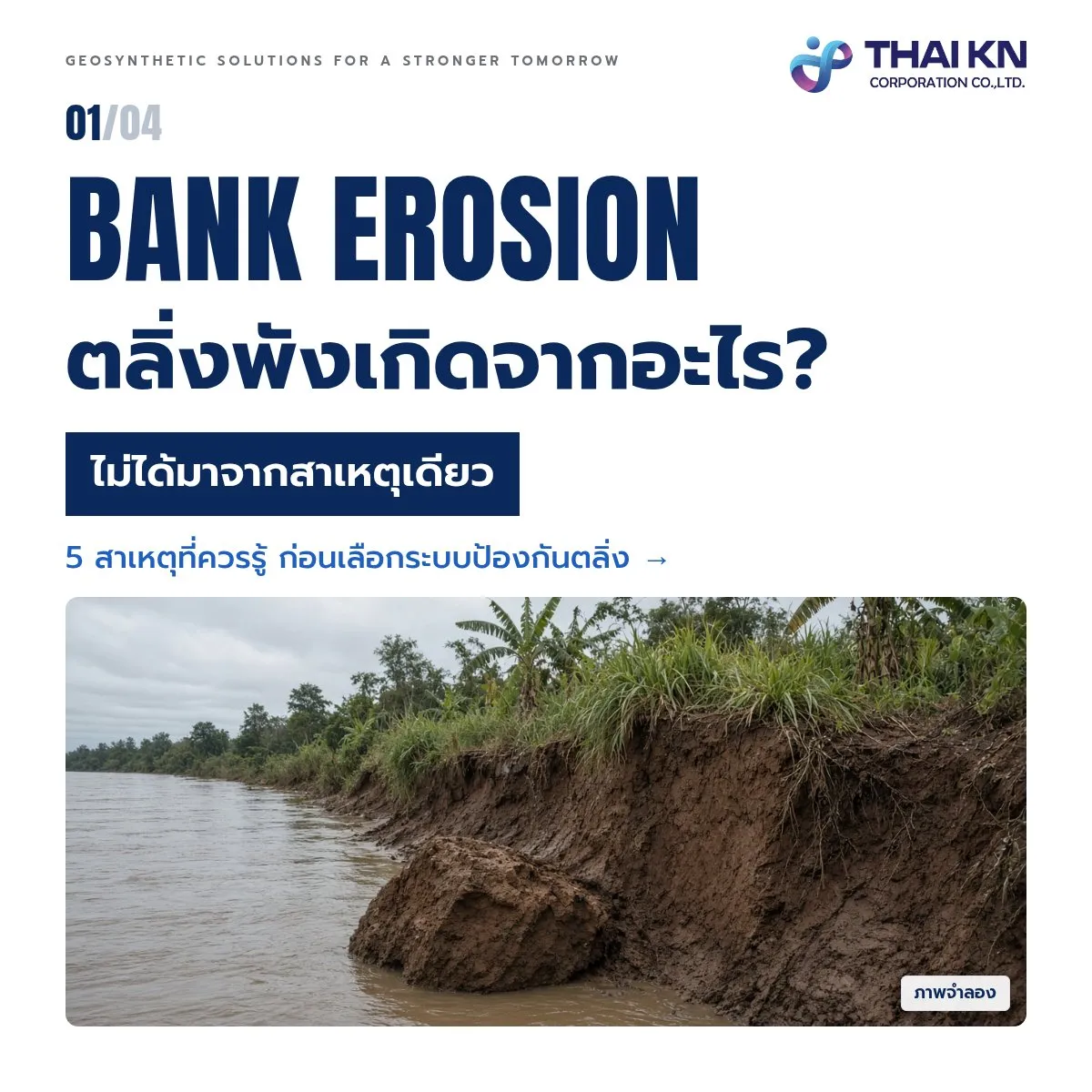
Riverbank erosion can occur along rivers, canals, reservoirs, storage ponds, drainage channels and any area in contact with flowing water. When soil on the bank face is carried or washed away continuously, the bank may lose its shape, retreat, or affect the stability of the surrounding area.
The issue is that each cause needs a different material “function”. Some points need material confined on the slope face; some need a filter layer that keeps soil particles from escaping while still letting water through. A system should therefore be chosen in light of the site conditions, slope, soil properties, water level, the speed and direction of the current, and the forces that actually occur.
FHWA HEC-23 states that the design of countermeasures must consider the soil characteristics and geotechnical conditions of the site, which may include an analysis of bank-slope stability under rapid drawdown, and that a geotechnical engineer should be involved.
See an overview of the full system at the bank protection and erosion-control system
- THAI KN, Bank Protection & Erosion Control
- FHWA, HEC-23 Bridge Scour and Stream Instability Countermeasures, 3rd Edition, Volume 1 (FHWA-NHI-09-111) — Section 4.1 Countermeasure Design Approach
What function does each type of geosynthetic perform in riverbank work?
The International Geosynthetics Society (IGS) explains that the main functions of a geosynthetic are defined in ISO 10318-1, and that most materials do not perform only one function. THAI KN’s bank-protection page therefore recommends choosing a material from the function required, rather than from the product name alone.
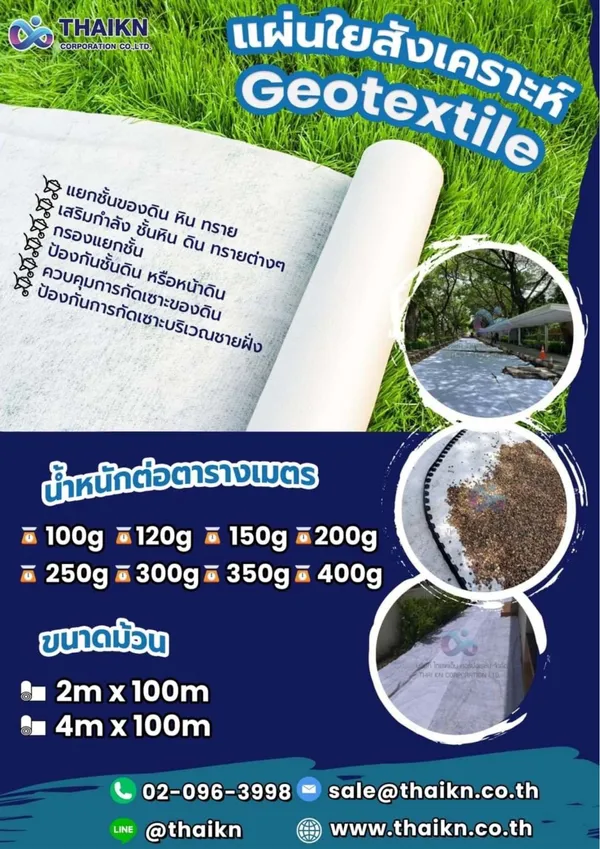
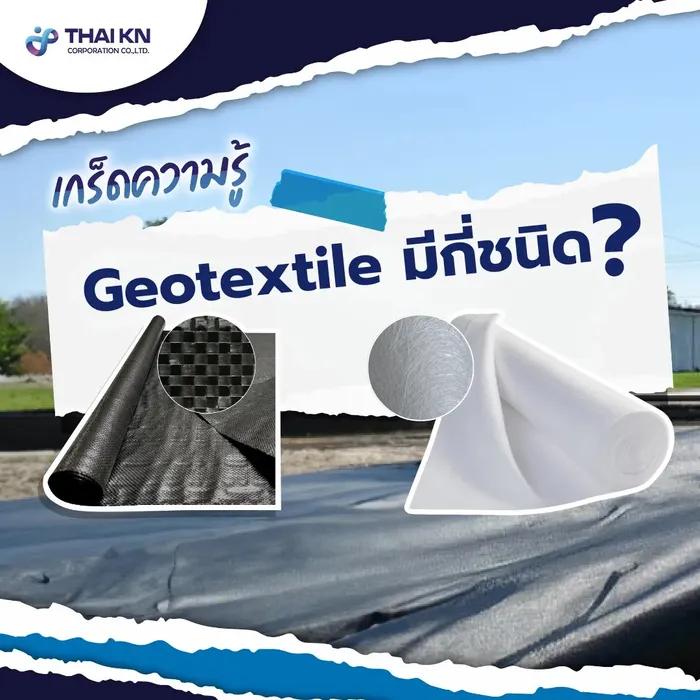
- Non-woven Geotextile — Made from synthetic fibres bonded without weaving. The main benefits are separation, filtration and drainage. Water can pass through. It is also used to control erosion of the soil layer, including in irrigation, canals and coastal work → Non-Woven Geotextile
- Woven Geotextile — Woven from fibres in a regular pattern, so the structure is dense and has high tensile strength, but its ability to let water pass through is reduced. The main benefits are separation and reinforcement → Woven geotextile
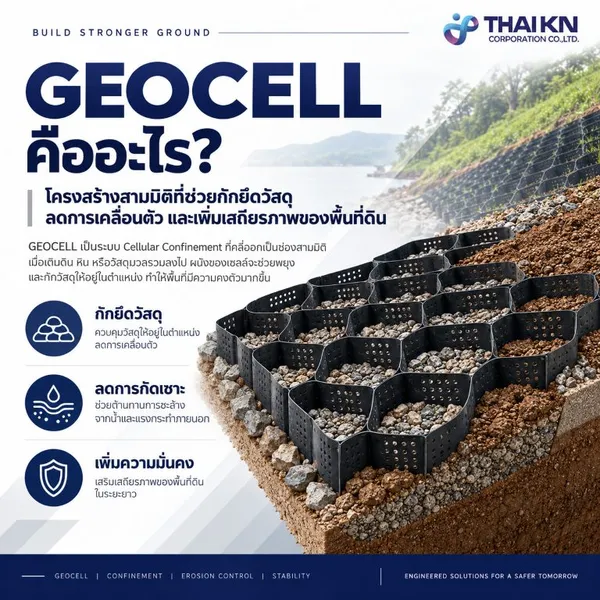
- GEOCELL — A three-dimensional honeycomb cell structure made from HDPE, which confines soil, stone or aggregate in the cells, reduces sideways movement of the material, and can be used together with ground-cover planting → GEOCELL cellular confinement mesh
- Geogrid — IGS states that geogrid is used to add tensile strength to a soil mass, to build steep slopes and reinforced-soil walls. THAI KN describes uses in retaining walls and in maintaining slope stability → Geogrid soil reinforcement grid and Soil reinforcement systems with geosynthetics
- GCL (Geosynthetic Clay Liner) — IGS places GCL in the barrier function, that is, limiting the flow of liquids, for example in reservoirs and storage ponds. This is a different function from surface erosion control, so GCL should be considered when a project needs to hold water, not as a material for controlling erosion of the bank face.
- International Geosynthetics Society (IGS), Geosynthetic Functions
- THAI KN, Bank Protection & Erosion Control
- THAI KN, Non-Woven Geotextile product page
- THAI KN, Woven Geotextile product page
- THAI KN, Geocell product page
- THAI KN, Geogrid product page
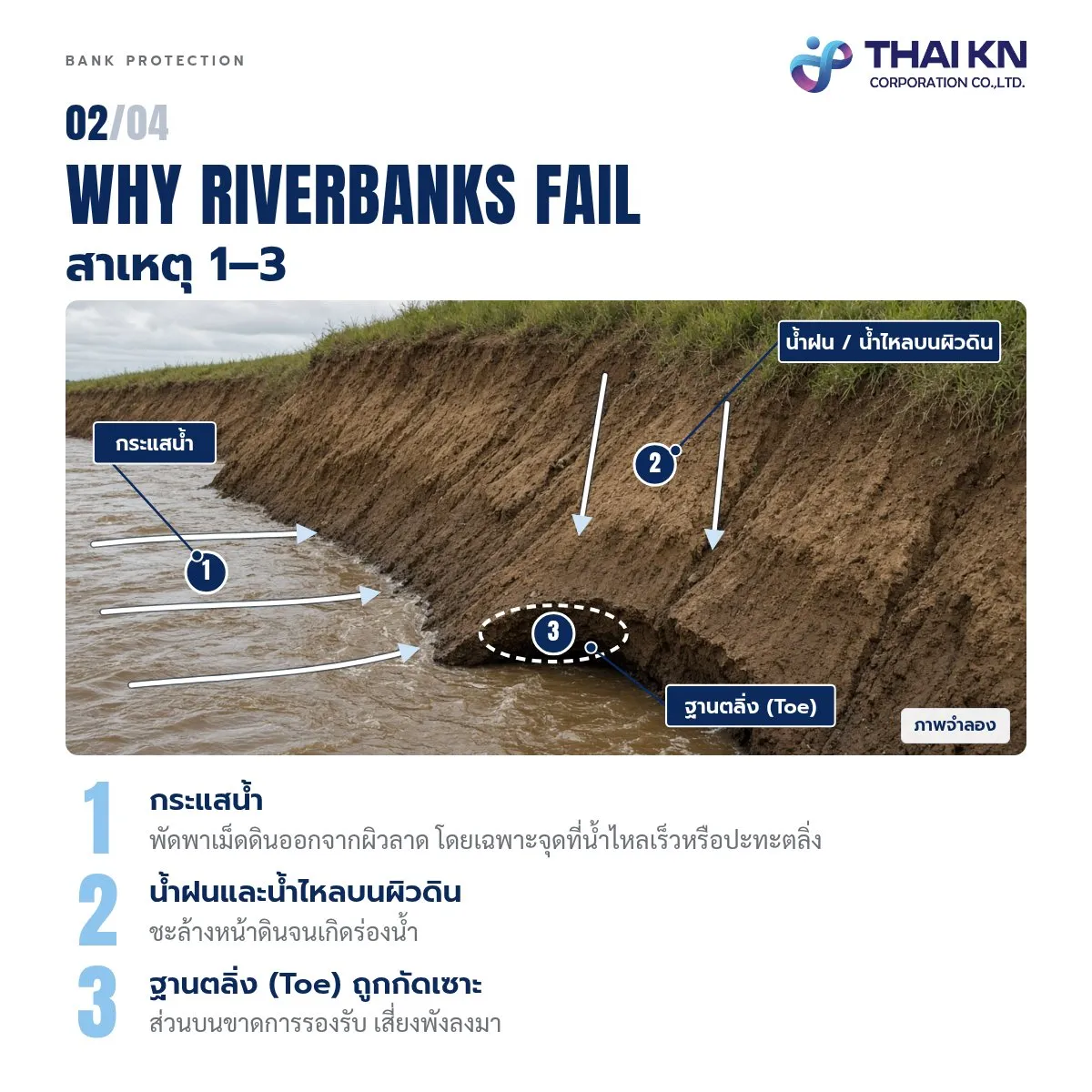
Causes 1–3: current, rainfall and the bank toe
1. Current eroding the bank — A current can carry soil particles away from the slope face, especially where the water flows quickly, changes direction or strikes the bank line directly. When this continues, the bank gradually loses material and changes shape.
2. Rainfall and surface runoff — Rainwater flowing down the bank slope washes the topsoil until rills form, and carries surface material into the water. Without a suitable system to control the flow and protect the surface, the problem can become more severe.
3. Loss of soil at the bank toe — If the current continuously erodes material at the toe, the upper part of the slope may lose its support and begin to move or collapse.
- THAI KN, Bank Protection & Erosion Control — Topics: current eroding the bank / rainfall and surface runoff / loss of soil at the bank toe
- FHWA, HEC-23 Bridge Scour and Stream Instability Countermeasures, 3rd Edition, Volume 1 (FHWA-NHI-09-111) — Section 5.1 Overview and Section 6.8.1 Streambank Zones
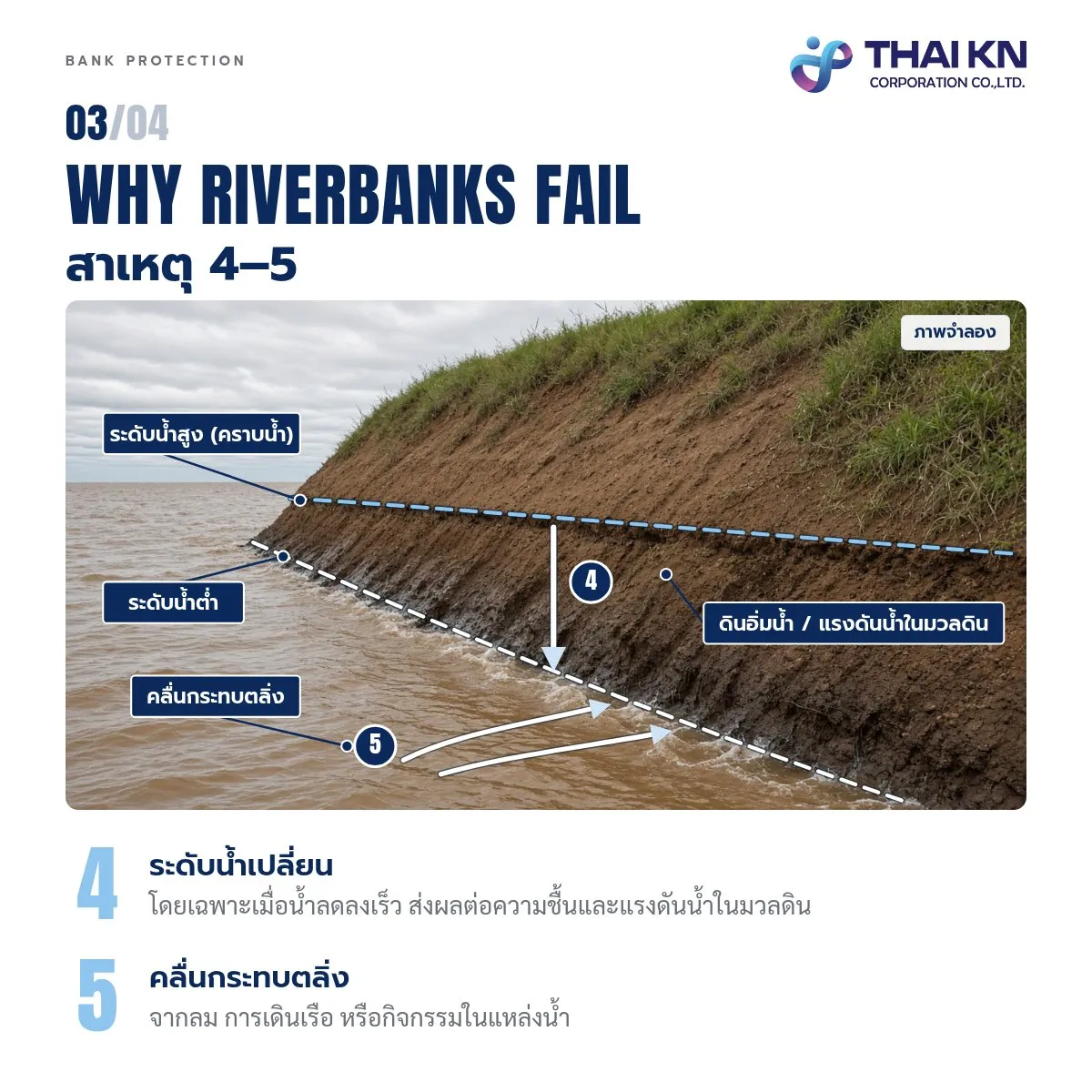
Causes 4–5: changing water levels and waves striking the bank
4. Changing water levels — The rise and fall of the water level affects moisture and pore-water pressure in the soil mass, especially when the external water level drops rapidly. This condition should be considered together with the stability of the bank slope.
5. Waves striking the bank — Waves from wind, navigation or activity on the water strike the waterline repeatedly, washing soil and material off the bank face, especially where there is no surface protection.
- THAI KN, Bank Protection & Erosion Control — Topics: changing water levels / waves striking the bank
- FHWA, HEC-23 Bridge Scour and Stream Instability Countermeasures, 3rd Edition, Volume 1 (FHWA-NHI-09-111) — Glossary: “rapid drawdown”, Section 4.1 Countermeasure Design Approach and Section 6.8.1 Streambank Zones
GEOTEXTILE as a filter and separation layer: why riverbank work should start by considering non-woven
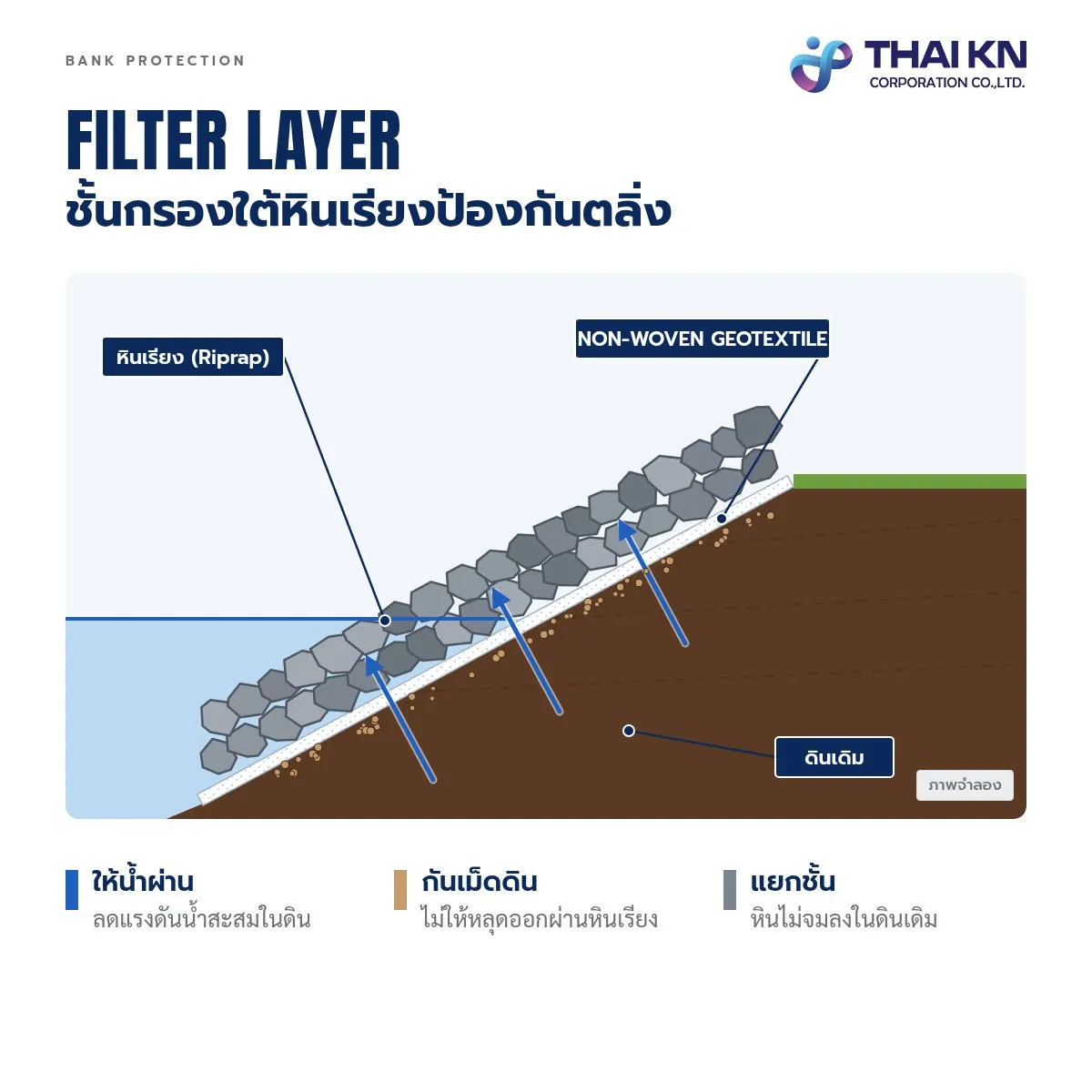
In a riprap bank-protection system, GEOTEXTILE can be installed between the existing soil and the stone to act as a filter and separation layer, controlling the movement of soil particles from below while still allowing water through according to the properties of the material. The system should therefore be considered not only in terms of stone size, but also in terms of the properties of the filter layer and the supporting soil.
HEC-23 explains that a filter layer (geotextile or granular material) placed between the bank-protection material and the soil has three functions: to prevent soil from moving through the protection material, to prevent the protection material from sinking into the soil, and to allow water to drain out of the bank so that pore-water pressure does not build up. It also states that the filter is an important part of the long-term performance of an armour system, which is consistent with the IGS definition of filtration: restraining movement of soil particles acted on by water, while still allowing liquid to pass through.
Why point to non-woven? THAI KN’s product pages state that non-woven geotextile has main benefits in separation, filtration and drainage, and that water can pass through, while woven geotextile has a dense structure that reduces its drainage capacity. For a filter layer under riprap or under GEOCELL that must let water through, non-woven is therefore a starting point that matches the function, but the actual engineering values still have to be checked against the soil on site.
See an example of using GEOTEXTILE as a filter and separation layer behind a riverbank structure at riverbank wall reinforcement with GEOTEXTILE and GEOGRID
- THAI KN, Bank Protection & Erosion Control — Topics: Riprap Protection with GEOTEXTILE and the FAQ “Why is GEOTEXTILE used in riverbank protection?”
- THAI KN, Non-Woven Geotextile product page and Woven Geotextile product page
- FHWA, HEC-23 Bridge Scour and Stream Instability Countermeasures, 3rd Edition, Volume 1 (FHWA-NHI-09-111) — Glossary: “filter”, Section 5.1 and Section 5.3 Filter Requirements
- International Geosynthetics Society (IGS), Geosynthetic Functions — Filtration
- THAI KN, What is WOVEN GEOTEXTILE? Its Key Functions in Earthworks and Road Works
- THAI KN, Installation of GEOTEXTILE and GEOGRID to reinforce a riverbank wall
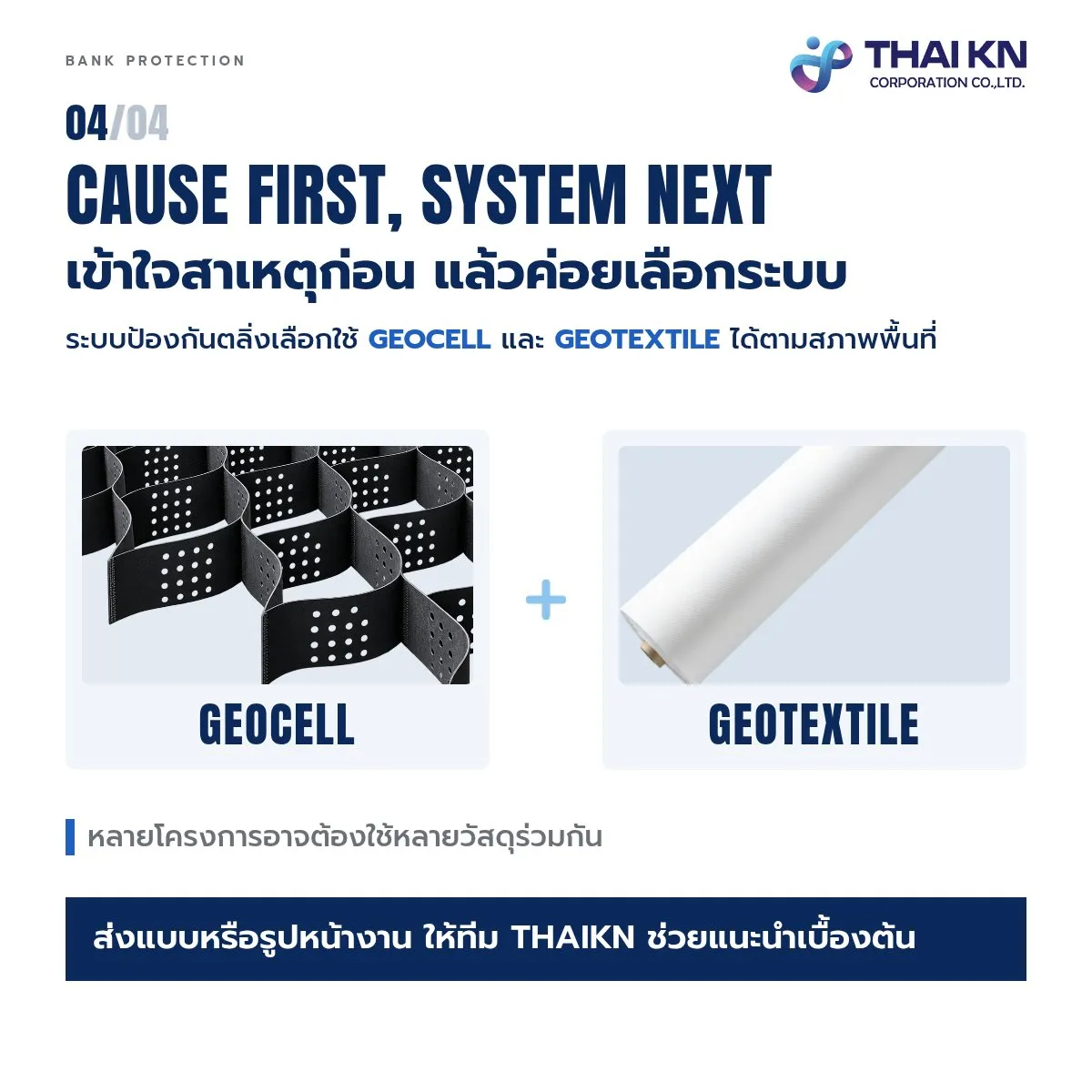
GEOCELL + GEOTEXTILE: confine material on the slope face, then choose the system according to the site
GEOCELL has a three-dimensional cell structure that is filled with soil, stone or aggregate, to confine and limit movement of material on the slope face. It can be applied to a riverbank slope to reduce surface erosion, and may be installed together with GEOTEXTILE as a filter or separation layer underneath. For banks that need a green area, GEOCELL can be used together with soil and ground-cover plants.
The type of fill, the anchoring system and the installation details must be chosen to suit the speed of the water, the slope and the hydraulic conditions of the site. This matches the IGS surface erosion control function: preventing or limiting movement of soil on the slope face, including protecting river and canal banks from erosion by flowing water.
Product details: GEOCELL cellular confinement mesh
- THAI KN, Bank Protection & Erosion Control — Topics: GEOCELL Bank & Slope Protection / Vegetated Bank Protection
- THAI KN, Geocell product page — Topic 02, riverbank and waterway protection
- International Geosynthetics Society (IGS), Geosynthetic Functions — Surface Erosion Control
- FHWA, HEC-23 Bridge Scour and Stream Instability Countermeasures, 3rd Edition, Volume 1 (FHWA-NHI-09-111) — Section 6.8.1 Streambank Zones (Bank Zone)
Applications in riverbank work
GEOCELL Bank & Slope Protection
Confines soil, stone or aggregate on the bank slope to reduce surface erosion, installed together with GEOTEXTILE as a filter or separation layerRelated materials: GEOCELL + GEOTEXTILE
Riprap Protection with GEOTEXTILE
GEOTEXTILE placed between the existing soil and the riprap, acting as a filter and separation layer and controlling the movement of soil particlesRelated materials: GEOTEXTILE (consider non-woven for filtration and drainage functions)
Vegetated Bank Protection
Uses GEOCELL together with soil and ground-cover plants to control loss of topsoil and create a green area, on sites where the flow conditions allow plants to be usedRelated materials: GEOCELL
Channel Protection
For canals and drainage channels, GEOCELL is used to confine material on the bed and sides of the channel, together with GEOTEXTILE for filtration or separation, taking into account flow velocity, fill material and slope.Related materials: GEOCELL + GEOTEXTILE
- THAI KN, Bank Protection & Erosion Control — Topics on the bank-protection system (GEOCELL Bank & Slope Protection, Riprap Protection with GEOTEXTILE, Vegetated Bank Protection, Channel Protection)
- THAI KN, Non-Woven Geotextile product page
Non-woven and woven geotextile in riverbank work
NON-WOVEN GEOTEXTILE
- Structure: fibres bonded without weaving
- Main functions: separation, filtration, drainage and control of soil-layer erosion
- Water can pass through
- Suitable role: a filter layer under riprap or under GEOCELL that must let water through
WOVEN GEOTEXTILE
- Structure: woven regularly in the MD/CD directions
- Main functions: separation and reinforcement, with good tensile strength and tear resistance
- The dense structure reduces drainage capacity
- It is also described as being used for bank-erosion protection, so the choice must follow the function the system needs
Each geotextile product must have its actual engineering values checked from the TDS and be selected to match the function of the project. For a filter layer, a sheet that is too fine may clog until pore-water pressure builds up in the soil.
View product details Non-Woven Geotextile and Woven geotextile
- THAI KN, Non-Woven Geotextile product page
- THAI KN, Woven Geotextile product page
- THAI KN, Bank Protection & Erosion Control
- THAI KN, What is WOVEN GEOTEXTILE? Its Key Functions in Earthworks and Road Works
- FHWA, HEC-23 Bridge Scour and Stream Instability Countermeasures, 3rd Edition, Volume 1 (FHWA-NHI-09-111) — Section 5.1
Checklist before choosing a riverbank protection system
- Condition and type of the soil
- Height and slope of the bank
- Speed and direction of the current
- Maximum and minimum water levels, and changes in water level
- Waves and forces from the water
- The drainage system and the condition of the bank toe
- Materials used in the system, and the required service life
- A bank-slope stability analysis (including rapid drawdown) by a geotechnical engineer
- A plan to inspect the system at intervals after floods
- THAI KN, Bank Protection & Erosion Control — Factors that should be considered in the design
- FHWA, HEC-23 Bridge Scour and Stream Instability Countermeasures, 3rd Edition, Volume 1 (FHWA-NHI-09-111) — Section 4.1 Countermeasure Design Approach
Summary: what causes riverbank failure?
A riverbank can fail from five main causes: current, rainfall and surface runoff, erosion of the bank toe, changing water levels, and waves striking the bank, which often occur together. There is no single bank-protection material that suits every site, and many projects may need several types of geosynthetic together so that each material performs a different function within one system.
GEOCELL helps confine material on the slope face, while GEOTEXTILE acts as a filter and separation layer. Non-woven is the type for which THAI KN states main functions in filtration and drainage, while geogrid has a role in soil reinforcement. Understand the causes first, then choose the system
See further installation examples at THAI KN installation projects (case studies)
- THAI KN, Bank Protection & Erosion Control
- THAI KN, Non-Woven Geotextile product page
- International Geosynthetics Society (IGS), Geosynthetic Functions
- THAI KN, Geogrid product page
Not sure which protection system your riverbank site needs?
If you have construction drawings, site photos, soil data or details of the area, send the information and the THAIKN team can give preliminary advice on use.